
What is hydroseeding? How it works and when to use it
Hydroseeding is a hydraulic seeding method that sprays a slurry of seed, water, mulch and fertiliser onto prepared ground using specialist equipment.
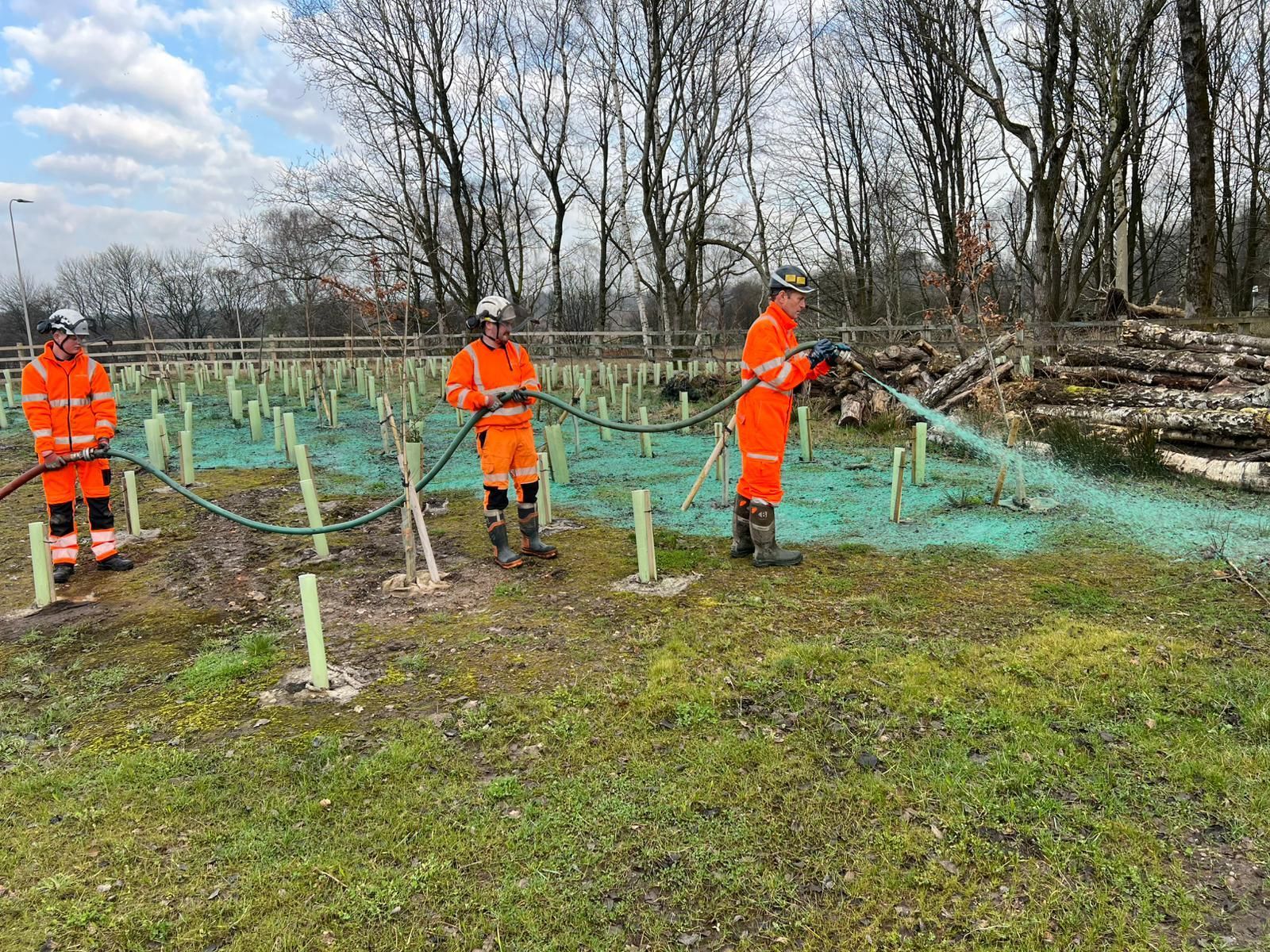
The mulch protects seed from erosion and retains moisture during establishment, while hydraulic application allows rapid, uniform coverage across large areas, steep slopes and sites with restricted access. This guide is published by CDTS North & West, UK hydroseeding contractors; for specification and quotes see our commercial hydroseeding services.
In the UK it is widely used on highway and rail embankments, housing developments, landfill restorations, quarry reclamation, SuDS features and Biodiversity Net Gain wildflower establishment. Where slopes are too steep for conventional seeding or where programme speed is critical, it is often the most practical and cost-effective option.
No UK institutional definition
There is no CIRIA, British Standard or Defra definition of hydroseeding. For procurement managers, ecologists and site managers seeking reliable technical guidance, verified contractor and industry sources remain the primary reference point, which is exactly what this page is for.
How does hydroseeding work?
A purpose-built machine mixes and sprays a liquid slurry directly onto prepared ground. The process follows the same sequence whether the site is a motorway embankment or a residential SuDS pond.
The Hydroseeding Slurry
A standard mix combines five components in the hydroseeder tank with continuous mechanical agitation:
Specified for site conditions, soil, aspect and project objectives. Mixes range from standard amenity grass to native wildflower blends for BNG compliance. Wildflower mixes are typically sown at an 80:20 grass-to-wildflower ratio at 3–5 g/m². UK suppliers include Emorsgate Seeds, Germinal and British Seed Houses.
The protective layer. Retains moisture, prevents washout and, in advanced formulations, provides immediate erosion control. A dye in the mulch gives operators a real-time visual marker for even coverage. Three main categories are shown below.
A biodegradable binder that adheres mulch and seed to the soil surface. Guar-gum products biodegrade in 3–6 months. BFM products use cross-linked hydrocolloid binders that form an insoluble bond once cured.
Typically a natural fast-release fertiliser, sometimes combined with slow-release granules and biostimulants such as mycorrhizal fungi. For wildflower mixes, fertiliser is minimised or omitted to prevent grass dominance.
The carrier medium. Water-to-material ratios of roughly 10:1 to 15:1 determine slurry consistency, spray distance and coverage per tank load.
Mulch types and erosion performance
100% recycled paper fibre. Best suited to flat or gentle slopes with irrigation available.
The general-purpose workhorse. Ideal for moderate slopes and standard amenity seeding.
For steep slopes and critical erosion sites. Cures into a bonded, erosion-resistant matrix.
Source: Profile Products technical library. Percentages are based on US independent laboratory testing. No equivalent UK regulatory testing data exists.
From site assessment to establishment.
Every hydroseeding project on a UK site follows the same sequence, whether treating 500 m² or 5 hectares.
Site assessment & specification
Slope gradients, soil type, access, erosion risk and ecological requirements are reviewed. A site-specific seed mix and application specification are agreed, with a soil test where specified.
Ground preparation
The seedbed is prepared for good seed-to-soil contact through cultivation, stone removal, levelling or surface debris clearance. This is the single most important factor in establishment success, regardless of method.
Slurry mixing
Water, binder, mulch and seed are added to the tank at specified rates. A mechanical agitator runs continuously to maintain a homogeneous slurry throughout mixing and application.
Application
The slurry is sprayed via tower-mounted cannon or hose and nozzle. Overlapping passes and the mulch dye ensure uniform coverage. A 6,000-litre tank load typically treats 2,000–3,000 m².
Curing (BFM/EFM only)
If Bonded Fibre Matrix products are used, 4–24 hours of drying allows the matrix to bond to the soil surface and form an erosion-resistant blanket.
Germination & establishment
Under optimal UK conditions (soil above 5°C, adequate moisture), visible germination appears within 7–14 days. Full vegetation establishment follows in 6–8 weeks, with monitoring visits scheduled throughout.
The right machine for the site.
Hydroseeders range from compact towed units of ~2,000 litres up to lorry-mounted machines of 6,000 litres or more.
| Equipment | Tank Capacity | Daily Coverage | Best For |
|---|---|---|---|
| Lorry-mounted | 6,000 L | 2–3 hectares | Large-scale highway, rail & infrastructure schemes |
| Towed unit | 2,000–4,000 L | 1–1.5 hectares | Restricted-access sites, smaller areas, rough terrain |
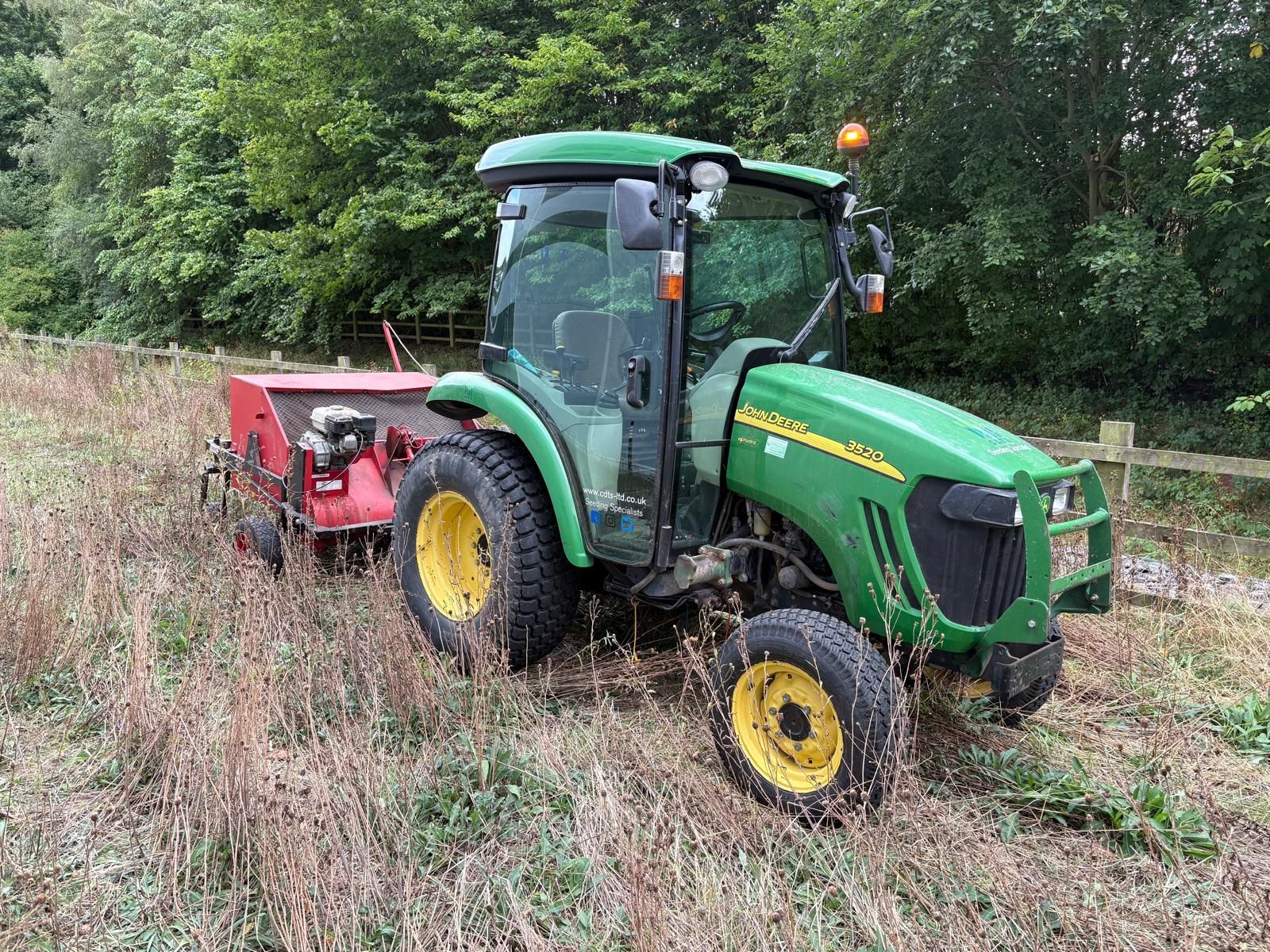
CDTS North & West operates a fleet of 6 hydroseeders ranging from compact towed units to large lorry-mounted machines, providing the capacity to match equipment to site conditions. For full fleet details, see our specialist equipment page.
What hydroseeding is used for.
Used across UK construction, infrastructure and ecological projects. Its combination of rapid coverage, erosion protection during establishment and access to difficult terrain makes it effective in the applications below.
Highway & Rail Embankments
↗Motorway embankments, A-road cuttings and rail corridor slopes. The MCHW Series 3000 includes specifications for hydraulic mulch seeding on highway earthworks. See our highway and rail embankments page.
SuDS Ponds & Attenuation Basins
↗Pond embankments and basin slopes, where wet-tolerant seed mixes and erosion protection during establishment are needed to meet adoption standards and discharge consent conditions. See our SuDS ponds and flood management page.
Landfill Restoration & Quarry Reclamation
↗Landfill caps and quarry benches present challenging substrates. Hydroseeding delivers seed, mulch and soil amendments in a single pass, with the mulch layer providing immediate protection against wind and water erosion. See our land reclamation page.
Biodiversity Net Gain & Wildflower
↗Under the Environment Act 2021, developments in England must deliver 10% biodiversity net gain. Hydroseeding enables precise wildflower application at much lower cost than plug planting or turf. See our wildflower and BNG seeding page.
Construction Site Erosion Control
↗CIRIA C532 and C811 identify rapid revegetation as a key erosion prevention measure. Standard hydroseeding provides 70–75% erosion reduction on slopes up to 3:1. For steeper slopes up to 1:1 (45°), BFM applications achieve up to 99%.
Other Applications
↗Wind farm access tracks and turbine platforms, airport surrounds, dam faces, reservoir embankments, coastal stabilisation, public open space on residential developments and brownfield regeneration.
Five practical advantages over conventional methods.
The operational and performance gains over dry seeding, turfing and manual methods that keep hydroseeding specified on critical UK schemes.
Coverage speed
A single lorry-mounted hydroseeder treats 2–3 hectares per day with a two-to-three-person crew. Drill seeding covers 1–2 hectares; turfing 0.2–0.5 hectares with a larger team. On programme-critical projects, the difference protects handover dates.
Erosion protection during establishment
The mulch layer protects bare soil from the moment of application. Standard wood fibre reduces erosion during the vulnerable germination window; BFM and EFM products bond to the surface and resist rainfall before root systems develop.
Access to difficult terrain
Slurry can be hose-applied up to 70 m from the machine, or cannon-applied from a stable position on hardstanding above a slope. This removes the need for operatives to work on unstable ground, a significant CDM consideration on earthworks projects.
Uniform seed distribution
Hydraulic application delivers seed evenly across the target area. The dye in the mulch gives the operator real-time feedback. Missed areas and overlaps are immediately visible, reducing the patchiness typical of broadcast seeding in windy conditions.
Flexible specification
The slurry composition is tuned per project. Seed mixes, mulch type, application rate, fertiliser and tackifier are all adjusted to match the site and ecology, from standard amenity grass through to complex BNG-specification wildflower mixes.
Where hydroseeding isn't the answer.
No seeding method suits every situation. Understanding where hydroseeding is not the best option is as important as knowing where it excels.
Smaller sites may not be cost-effective. For areas under 2,000 m², mobilisation costs mean a day rate applies rather than a per-m² rate. On very small areas, conventional seeding may be more economical. Current day rates are listed in the hydroseeding cost guide.
Seasonal constraints still apply. Hydroseeding is subject to the same seasonal limitations as any seeding method. The primary UK windows are March–May and August–October. Winter applications carry higher risk of poor establishment.
It does not provide instant cover. Unlike turfing, hydroseeding requires a germination and establishment period of 6–8 weeks. Where immediate green cover is needed for aesthetic or functional reasons, turf may be more appropriate despite the higher cost.
Hydroseeding vs the alternatives.
Slope gradient, programme, erosion risk and budget decide the method. The detailed comparison lives on its own page.
Hydroseeding suits slopes steeper than 4:1, large or awkward areas, tight programmes and sites with an erosion or compliance risk. Conventional drill seeding is the economical choice on flat, accessible ground with stable soil. Rolled erosion control blankets are specified where concentrated flow crosses a slope or where the specification demands them, and turf is reserved for small, high-visibility areas that need instant cover. On mixed sites, hydroseeding the slopes and drilling the flat areas in a single mobilisation is often the best-value approach.
For costs, speed, labour and erosion performance side by side, see hydroseeding vs conventional seeding; for steep slopes, see BFM vs erosion control blankets.
When should you hydroseed in the UK?
The working window runs March to October, with two peaks.
Early autumn (August to October) is the most reliable period: the soil still holds summer warmth, rainfall reduces the need for irrigation and weed competition is low. Mid-spring (April to May) is the second peak, with late frosts a risk in the north and at altitude. Outside the season, dormant seeding and winter-active cultivars extend the window, and BFM can be applied in winter to stabilise the surface and hold seed until temperatures rise.
Soil temperatures, regional windows and month-by-month guidance: best time to hydroseed in the UK.
How steep can you hydroseed?
Considerably steeper than any conventional method.
Standard wood-fibre hydroseeding is suitable to around 3:1 (18°). With Bonded Fibre Matrix the limit rises to 1:1 (45°), and high-performance fibre matrices with reinforcement have been applied to near-vertical faces. By comparison, drill seeding and turf are limited to about 4:1 (14°) and rolled blankets to about 2:1 (27°). Because the slurry is sprayed from the crest or toe, nobody has to work on the slope face, which removes a significant CDM risk.
See our steep slope erosion control page for how BFM is specified and applied on high-risk slopes.
What is Bonded Fibre Matrix (BFM)?
A spray-applied erosion control mulch that replaces rolled blankets on steep or high-risk slopes.
BFM combines long-strand wood fibres with a cross-linked hydrocolloid binder. Sprayed from the hydroseeder and left to cure for 4 to 24 hours, it bonds to the soil as a porous, erosion-resistant blanket that stays intact when re-wetted, provides up to 99% erosion reduction in manufacturer testing, and biodegrades after roughly six months once vegetation has taken over. Unlike double-netted blankets it introduces no plastic netting or metal staples to the site.
The BFM, EFM and FGM variants, and when each is specified, are covered in our complete guide to Bonded Fibre Matrix.
Hydroseeding for Biodiversity Net Gain.
Under the Environment Act 2021, developments in England must deliver at least 10% biodiversity net gain, maintained for 30 years.
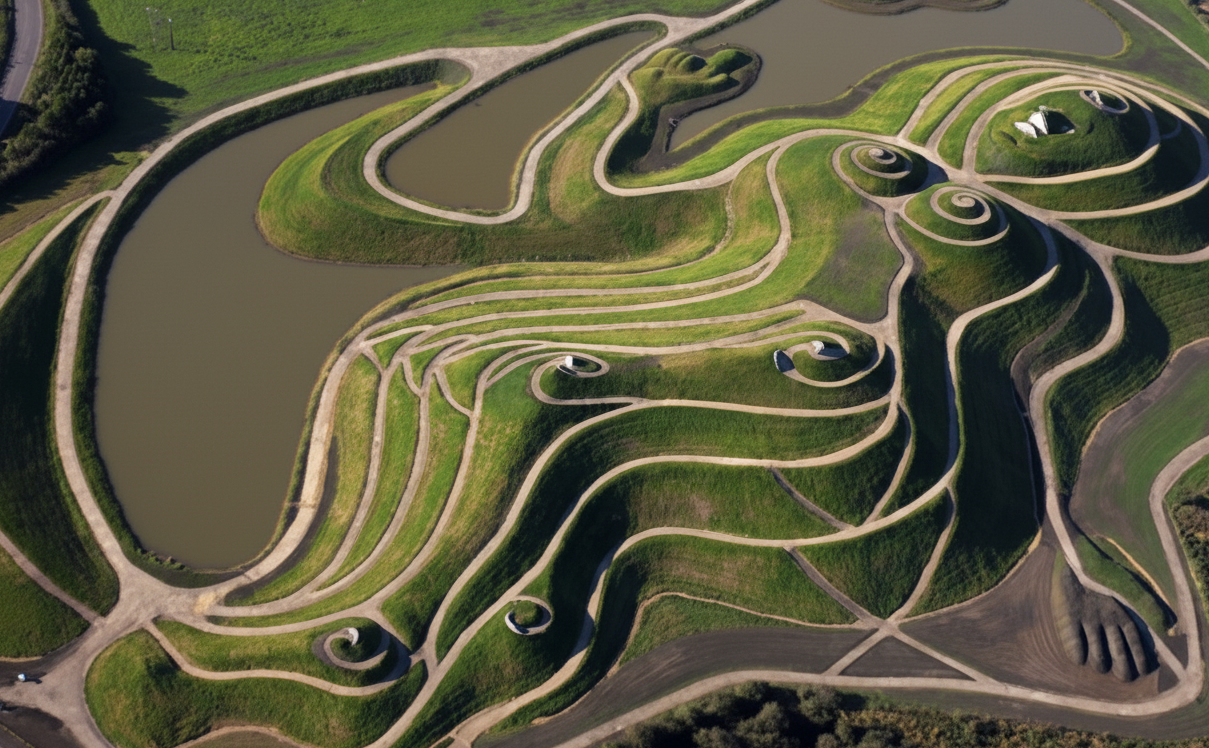
Hydroseeding is a recognised way of creating the grassland and wildflower habitats that generate biodiversity units. It places specified, locally sourced mixes evenly across large or difficult areas, and the 30-year management period runs from completion of seeding. Nurse grasses appear within 7 to 10 days and cornfield annuals flower in year one, but a diverse perennial meadow takes three to four years and depends on low soil fertility, appropriate seed provenance and effective weed control.
For specification and delivery, see our wildflower and BNG seeding page and the guide to achieving 10% Biodiversity Net Gain.
Writing the hydroseeding specification.
Three variables dominate the spec, and each has a direct effect on establishment.
Seed mix. Chosen for soil, aspect, climate and the project objective: amenity grass at 25 to 35 g/m², wildflower and species-rich mixes at 3 to 5 g/m² so forbs are not out-competed, fast-establishing erosion control mixes, or tree and shrub mixes for direct woodland establishment.
Mulch type and rate. Standard wood fibre at 100 to 200 g/m² for moderate slopes; BFM or EFM at 200 to 350 g/m² above 3:1 or wherever immediate erosion protection is required.
Tackifier and fertiliser. Tackifier to the manufacturer's rate for the product; starter fertiliser or biostimulants where the soil is nutrient-poor, and usually omitted on wildflower sites to keep fertility low.
Our commercial hydroseeding services page explains how we turn these variables into a priced specification for a scheme.
Standards and regulations relevant to UK hydroseeding.
The regulatory landscape references hydroseeding indirectly. No single document dominates. Here are the standards that actually apply, and some common misattributions to watch for.
British Standards
BS 4428:1989, the UK code of practice for general landscape operations, covers preliminary investigations, drainage, grading, cultivation, seeding and turfing. It remains current (confirmed December 2011) and is the primary BS relevant to seeding operations on UK construction sites. Also relevant: BS 3882 (topsoil specification), BS 6031 (earthworks) and BS 7370-4 (soft landscape maintenance).
National Highways: Specification for Highway Works
The Manual of Contract Documents for Highway Works(MCHW), Series 3000 Landscape and Ecology, covers landscape and ecological requirements for highways projects including seeding, ground preparation and grass maintenance. The MCHW was modernised and republished September 2025. Application method is typically the contractor's choice, subject to achieving specified outcomes.
Network Rail
NR/L2/OTK/5201, the Lineside Vegetation Management Manual (Issue 5, December 2020), uses a risk-based inspection regime. Network Rail's approach is increasingly aligned with BNG targets following the 2018 Varley review.
CIRIA Publications
Common misattribution
No CIRIA publication is specifically dedicated to hydroseeding performance or BFM specifications. Some online sources incorrectly cite CIRIA references for hydroseeding. CIRIA C760 covers embedded retaining wall design, not erosion control. BS 8616:2019 covers green roof substrates, not hydroseeding. Any source citing these for hydroseeding is incorrect.
The relevant CIRIA documents are:
- CIRIA C532(2001): Control of water pollution from construction sites. Covers sediment and erosion control as part of broader water pollution prevention.
- CIRIA C753(2015): The SuDS Manual. Covers vegetation as a component of SuDS features. Free PDF download.
- CIRIA C811(2023): Environmental good practice on site guide (5th edition). Supersedes C741. Incorporates Environment Act 2021 requirements.
Environment Act 2021 & BNG
The Environment Act 2021 mandates a minimum 10% biodiversity net gain on most developments in England. The Defra Statutory Biodiversity Metric is the calculation tool and is directly relevant to wildflower hydroseeding specifications.
SuDS requirements
Schedule 3 of the Flood and Water Management Act 2010 has not been commenced in England as of March 2026. It was commenced in Wales on 7 January 2019. In June 2025, the government published new national standards for SuDS as non-statutory guidance. For more on how hydroseeding integrates with SuDS construction, see our SuDS ponds and flood management page.
Environmental & sustainability considerations.
All standard hydroseeding materials are fully biodegradable and non-toxic, with significant environmental advantages over alternative methods.
Biodegradability
Cellulose mulch is 100% recycled paper fibre. Wood fibre mulch is thermally refined virgin wood. Guar-gum tackifiers biodegrade fully within 3–6 months. BFM and EFM matrices are designed to biodegrade after vegetation establishes.
Comparison with alternatives
No published lifecycle assessment specific to hydroseeding has been identified. But the environmental advantages are clear in practical terms. A single hydroseeder treats 2–3 hectares per day, while turfing 1 hectare at 15–20 kg/m² requires approximately 150–200 tonnes of turf delivered by multiple HGVs. Each load involves turf cultivation, fertiliser, pesticide, water, harvesting and refrigerated transport.
Rolled erosion blankets introduce significant plastic and metal staples to site. Hydroseeding with BFM achieves equivalent or superior erosion protection using only natural, biodegradable products.
Discuss your project
This guide explains the method. If you are specifying hydroseeding for a live scheme, our commercial hydroseeding services page covers what we deliver, the sectors we work in and how to get a fixed quote.
Frequently asked questions.
Answers to the most common questions from procurement managers, site managers and specifiers about hydroseeding in the UK.
The takeaway.
Hydroseeding is a proven, widely used vegetation establishment method across the UK construction and infrastructure sector. It combines rapid coverage, erosion protection during establishment, access to difficult terrain and flexible specification in a single mechanised application. For sites where conventional seeding is too slow, too limited in slope capability or too labour-intensive, hydroseeding provides a cost-effective and technically sound alternative.
The choice of method should be driven by site conditions, slope gradients, programme requirements, erosion risk and budget. On most sites, hydroseeding works best as part of an integrated vegetation strategy, combined with proper ground preparation, appropriate seed specification and post-application establishment monitoring.